

100 words a day

Y2K
And in the end, ‘nothing happened’. Many of us will remember the late 1990s, when all thoughts turned to the bug in computers around the world. Some digital timekeeping stored 2-digits for the 4-digit year, so 1900 was indistinguishable from 2000.
Oh, the calamity predicted, and solved, at the time. So, when the clocks ticked over and we carried on, there was a cry that it was all a hoax and a beat-up.
I guess we’ll never know, because there’s no parallel universe where nothing was done, to compare.
This is risk management’s challenge: if it’s done right, nothing happens.

Stakes
A stake could be a wooden or metal post with a point on one end, or, more likely in this forum, a stake is something of value that depends on the outcome of an event, adventure or competitive situation.
In the second definition, stakes are the result, emotion, or thing that can be gained or lost, when you take chances.
Stakes are why we compete, why we go on rollercoasters, why we watch sports and why we sweat before job interviews.
When stakes are involved, it follows that risk is involved. When assessing risk, keep the stakes in mind, too.
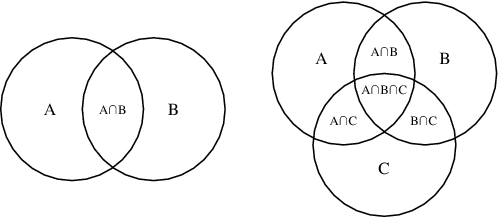
Threes
There is symmetry in threes. Our brains like to think in threes, because it is a pattern: three is the lowest figure that can be used to form patterns in our mind. A good Venn diagram can demonstrate the value of three.
It happens elsewhere too – in triathlons, in the three acts in a play, or setting up for photography, trilogies in film, in making a point, in categorising, clustering, or organising.
Three golden threes that I like to keep on top of, for any project or goal, are:
• Project management triad: Cost/Scope/Schedule
• Productivity triad: People/Process/Tools
• Professional excellence triad: Risk/Quality/Competence

Need to KNow
New information doesn’t stick generally and reliably, unless you’re at a moment where you actually need to know it.
Education is different from training: education is a broader approach to information which might be used or needed at some time in the future. Training, or ‘learning on the job’, is just that: acquiring new information at the moment you need it.
Search engines make it so easy to search for facts you need “right now”. But when the knowledge needed is more nuanced, or judgement based, and you need to know the answer “right now”, that’s harder to search for.

Retrieval
Research shows a good way to learn is through retrieval: testing knowledge with flashcards, instead of simply reviewing a text over and over again.
While it might not feel like it, imposing the difficult task of trying to remember a fact or concept, without confidence that you know it, is actually more effective than re-reading something you think you already know.
Having ‘knowledge fluency’ is useful, as it means you can recognise something presented to you, but it doesn’t propagate. Being able to retrieve that information cold, means you’re more likely to be able to generate new thoughts and ideas.

Victory
Plan for victory.
One of Churchill’s strategies during WWII was to look fiercely into the future. A declaration statement about what will be done ‘after this is over’. Deep and clear visual imagery describing what the country will look like and where people will be.
Now put aside the complex responsibilities of Churchill, and put aside the similarities to the complex mess that we’re currently in.
Thinking in a more mundane sense, about our workday or documents or projects or meetings: it is the same. Plan for victory. Think about what the finish line looks like, and strive for that.
Re-Read
It’s easy to continually acquire new things to read. I’m certainly guilty of that pleasure. It happens by choice for some, and for others, it happens just through working with knowledge. There’s always something to read.
In addition to the new things to read, I recently had cause to go back and read something I’d written many months ago, which then referred to other reference sources, which I (fortunately) had time to read again.
It’s remarkable how useful it is, to go back and read something a second time. Unfortunately, quite often it’s hard to remember having read it before.

Price’s Law
If you belong to committees, regularly publish academic articles, or, work in a company, you’ve maybe been exposed to Price’s Law.
It estimates that 50% of the creative production output is done by the square root of the number of people involved. With 100 employees, 10 of them do half the work. That means 90 people do the other half. As a company grows (or a committee, or an academic body), creative competence grows linearly; incompetence grows exponentially.
If you manage a team, know who your square root is. If you are a participant, know if you’re contributing or coasting.

Internal
Memorable stories reflect internal change or an emotional realisation.
Stories that simply recount events, or describe ‘what happened’, might be interesting and entertaining, but the great ones illustrate change. This does not mean that great events or startling action need to have occurred: those stories may be entertaining but if there is no difference between before and after, then they are just an anecdote. With anecdotes, the listener likely won’t be moved, nor their view changed, and they won’t feel more connected to you. Stories worth telling are those where something has changed internally, not out there in the world.

Guide
A mentor guides, bears witness, and provides experienced, relevant assistance.
A good mentor shares learnings and perspectives, or even failures based on their own experience. However, the mentor’s experience is not the answer: that must be reached separately through discussion, from within the mentee.
A mentoring relationship is finite, not ongoing and dependent. The value of a good mentor, beyond knowledge transfer, is the ability to step in - and step away - at the right time.
The role of the mentor is to provide a robust space for experiential discussions, so that personal growth, confidence, and self-realisation can flourish.

Train
Teaching has been around for as long as humans have been. Even after a worldwide shock (!), the appeal of learning from effective trainers doesn’t diminish. In fact, existential change can increase the need for good trainers.
The role of a trainer is to establish a clear process for achieving an outcome, and then to explain that process in a step-by-step, easy-to-understand methodology.
The value of a good trainer, beyond their ability to explain content, is the ability to gauge progress and comprehension.
Good training sessions result in an identifiable change in the “before” and “after” knowledge of the participants.

Facilitate
A job description that didn’t exist a generation ago, but which is a valid role now, is that of “Facilitator”. A facilitator is the independent ‘director’ of a meeting or workshop which needs a specific conclusion or output.
The value of the facilitator is their ‘helicopter’ view, shining a light on the process, more than the content.
The role of the facilitator is to create space and manage the energy and engagement, making it easier to reach a conclusion.
In the end, though, it’s not about the facilitator. Good facilitators are hardly noticed; what’s noticed, rather, is the result.

Doing
Technical experts working in or consulting to a business are intricately focussed on doing rather than showing knowledge.
The technical specialists contribute to the business by doing tasks such as writing documents, creating designs, preparing justifications or checking the work done by others.
They use their deep technical knowledge to create a better business. This is different to excellent managers and leaders, who rightly spend more time showing and helping others succeed.
Sometimes it is difficult to convince management of the value brought through that technical expertise. Technical leadership is different to team or personnel leadership, but no less important.

Written
Work done in the built environment space gets done because details have been written down. Design companies, at the base of it, produce just pictures and words.
And so, it is so very important those pictures and words are clear, concise, and correct. Just because we have the ability to write long (long!) documents, that doesn’t mean that we always should.
Written communication forces higher precision in our critical thinking skills. A well-written document carries more weight than a verbal conversation, and that written document is also more permanent. Good writing goes a long way also to amplify leadership ability.

Uno
I make time for something called “uno time”.
“Uno time” is different to just time alone. “Uno” here is a shortened version of the word ‘unobligated’.
Sometimes even when we’re alone, we’re still obligated to be ready to converse with others, simply because they are in the vicinity and might talk at any time. Or we are obligated to follow the road rules or make small talk. So that’s not ‘uno’.
Being totally unobligated to others provides another level of freedom for thinking. Real “Uno Time” means you can wander free in your thoughts without being ready to be interrupted.

150
“Dunbar’s Number” emerged more than 10 years ago. It postulates that humans can only cognitively keep track of about 150 contacts in their community or sphere.
This is a useful number for office spaces, residential communities, marketers, and perhaps wedding planners.
This output was being presented and discussed 10 years ago, lamenting the increased use of screens and growing ‘followers’ for socialising.
The research also identified the importance of human touch, pointing out that while screen-based communication serves to ‘prevent the decay’ of an established relationship, it is still crucial to meet up at the pub to fully appreciate it.

Currency
Back in February (an age ago), I mused about the role of consuming and producing in our economy: we’re always either consuming or producing.
The next step in that thinking is about the economic sectors, which are:
Primary: Natural resources
Secondary: Manufacturing and processing
Tertiary: Services and distribution
Quaternary: Knowledge and information
The current scenario has us very focused on all those sectors, probably with a different view than we had six weeks ago. And the question I keep wondering, along with others I’ve spoken to, is –the money circulating furiously six weeks ago, I wonder where it has gone.

Fool
A good quadrant model can simplify, clarify, and organise scattered thinking. The best-known quadrant model these days is credited to Eisenhower; his “Important / Urgent” quadrant model. The four quadrants categorise the handing of information, based on importance and urgency, resulting in quadrants labelled “Do/Decide/Delegate/Delete”.
When I wrote the date for today’s post, I couldn’t get past “fool”; the date and label were inseparable. So, I just had to go with it.
Fortunately, I remembered I have developed a quadrant model for comparing different levels of knowledge versus thinking style. It’s clear which quadrant we don’t want to be in.

Skills
There’s no shortage these days of offers for newly minted free options for developing skills and gaining knowledge. In the current circumstances, the perceived ‘free time’ that people might have is being rapidly filled by offers of free training, free webinars, free (for now) streaming services.
Identifying the relevant, valuable, useful skills that will help in the future is a valid chore right now. Some of the opportunities that might be of interest are:
Drawing (including in particular, technical, architectural, electrical, scientific), photography, meditation, languages, programming/coding, public speaking, writing, and the old (new to me) chestnut: “Learning how to learn”.

Sort
I have an ‘electronic pile’ of email newsletters dating back to last July, which I’m finally working through. The first thing I did was sort them into categories of similar topics: for example, three of my many areas of interest (besides risk/quality/competence) are productivity, writing skills, and entertainment (bring on the funny dog videos).
Our brains are amazing, but also lazy. Jumping from topic to topic, in hazes of clouded information, is not an effective way to absorb information. I set aside 20-45mins a day, and it’s more satisfying when the time is spent on one newsletter type or topic.